Sección
The interview process has never been more vulnerable or more scrutinized than it is today. With the rise of generative AI tools available to every applicant, the normalization of fully remote interviews, and the increasing sophistication of identity manipulation, hiring teams are facing risks that did not exist five years ago. At the heart of this shift are two opposing forces: the AI tools candidates use to assist their applications, and the AI systems employers use to verify what they are actually seeing.
Together, they are not just changing how interviews happen, they are fundamentally reshaping what "passing an interview" means. Multi-layer fraud detection has moved from a nice-to-have feature to a baseline requirement for any AI interview platform that wants to be taken seriously. The gap between basic interview tools and serious AI interview software has never been more visible, and the verification stack underneath is one of the clearest tells.
The New Reality of Interview Fraud
Beyond resume embellishment, modern interview fraud takes forms that traditional hiring processes were never designed to catch.
Common fraud patterns in modern hiring include:
AI-generated answers read in real time during live interviews
Identity swaps where one person applies and another shows up to the interview
Deepfake video and voice used to disguise the actual candidate
Coached candidates rehearsing scripted answers to common questions
Fabricated profiles on LinkedIn or GitHub built specifically to pass cross-checks
Gartner has forecast that by 2028, 1 in 4 candidate profiles worldwide will be fake: AI-generated identities, impersonation in interviews, and deepfake candidates applying for remote roles they cannot actually perform. The risk is no longer theoretical, and a single fraudulent hire in a senior or sensitive role can carry costs that take a year of normal hiring to recover from.
Why Single-Signal Detection Falls Short
One of the main challenges in catching interview fraud is that no single signal is decisive on its own. A candidate who reads slowly might be thinking carefully. A candidate whose answers sound polished might simply have prepared well. A candidate whose webcam flickers might have a bad connection.
Traditional detection methods address this poorly because they:
Rely on a single indicator like keystroke patterns or response timing
Trigger false positives on candidates with disabilities or non-native English
Fail to verify identity continuity across multiple interview stages
Cannot distinguish between AI assistance and legitimate preparation
Produce alerts without supporting evidence the team can review
Modern platforms like Careerswift Hire take a different approach. Instead of relying on one signal, they run multiple independent verification streams in parallel and let the hiring team see how the signals stack up before any decision is made. This model supports honest hiring at scale, especially for fully remote roles where identity and authenticity cannot be verified in person.
The Five Layers of Fraud Detection
The real strength of modern fraud detection comes from how the layers work together. Each layer catches a different type of risk, and the combination is what makes the system reliable.
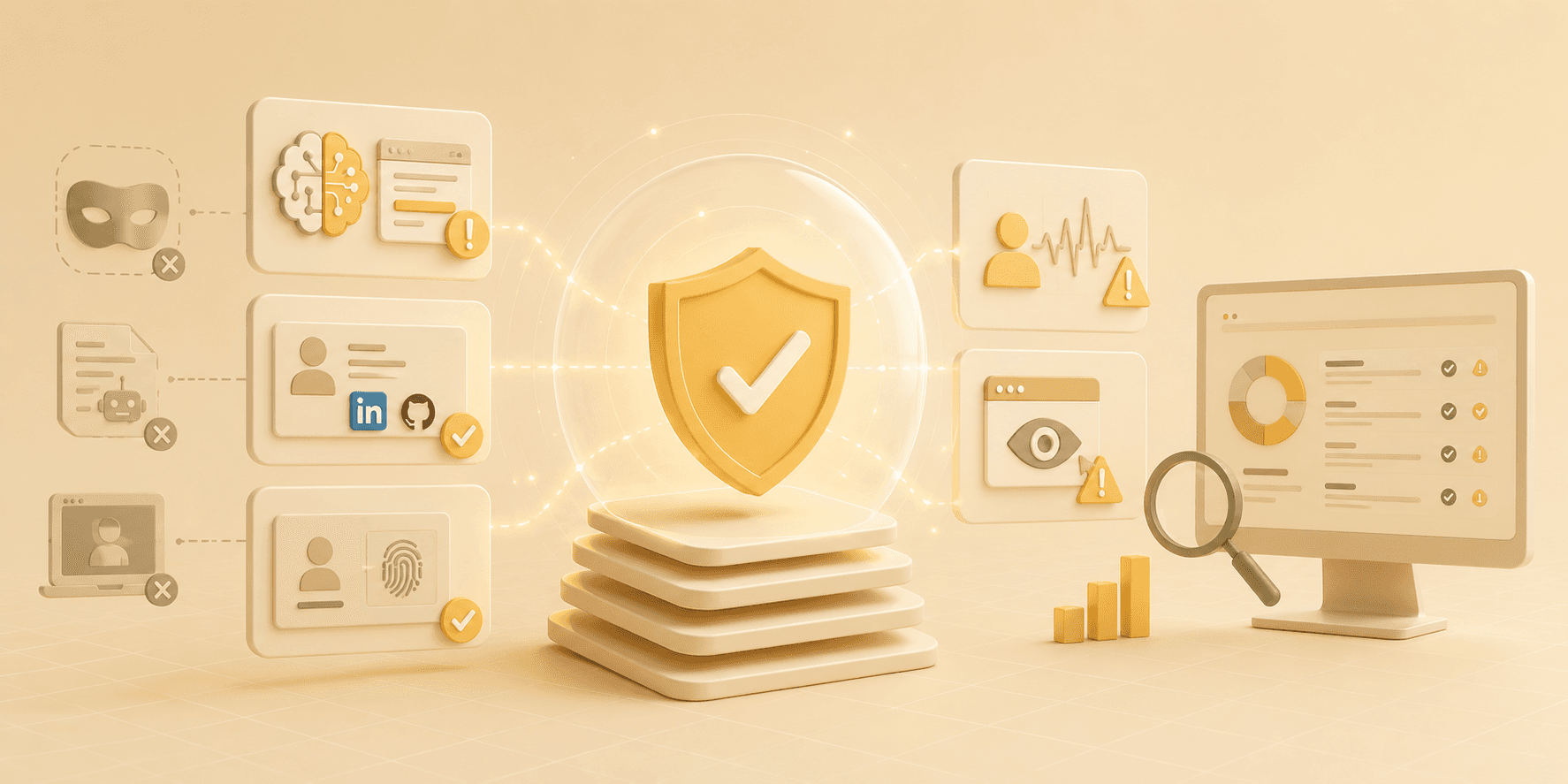
The five core layers in a modern AI interview platform:
AI Answer Detection. Identifies responses that show signatures of AI generation or plagiarized content during the interview, surfacing answers that appear copied or machine-produced rather than the candidate's own.
Profile Cross-Check. Validates the candidate's claimed identity and experience against public profiles on LinkedIn and GitHub, surfacing inconsistencies between what the resume says and what the candidate's professional footprint actually shows.
Identity Consistency. Cross-verifies the candidate's identity across every interview stage, ensuring the person who applied is the same person showing up to each subsequent step.
Behavioral Anomaly Detection. Flags unusual patterns and suspicious activity during the interview, the kinds of inconsistencies that rarely show up in a single answer but stand out when the interview is viewed as a whole.
Browser Focus Monitoring. Detects tab switching and window defocus during the interview, producing real-time alerts when the candidate's attention moves away from the interview window.
Each layer alone produces some false positives. The combination is what makes the system trustworthy. When multiple layers point to the same candidate, the hiring team has the structured evidence needed to act with confidence rather than gut feel.
Why This Matters for HR Teams
Multi-layer fraud detection means HR teams are no longer constrained by:
Manual reference checks that cannot verify remote candidate identity
Reliance on candidate self-reporting for experience and skills
Limited visibility into what is actually happening during a remote interview
The growing volume of AI-coached applicants who present well but cannot perform
Compliance exposure from hiring decisions that cannot be defended later
Instead, they gain:
Independent verification across multiple authenticity signals
Real-time alerts during live interviews, not after the offer is signed
Structured evidence to support hire and no-hire decisions
Consistent fraud screening applied to every candidate, not just suspicious ones
A documented process that respects candidate rights and aligns with GDPR
The hiring process becomes defensible rather than reactive.
Why This Matters for Hiring Managers
Hiring managers benefit from:
Higher confidence that the shortlisted candidate is the person they will actually onboard
Reduced exposure to mis-hires caused by AI-assisted answers in the interview
Transparent flags they can investigate rather than black-box rejections
Faster decisions on borderline candidates because the evidence is already structured
Consistency across roles, regardless of how senior or remote the position is
Authentic candidate verification removes the silent risk that has crept into remote hiring over the last two years, while structured evaluation ensures the decision logic stays human. Together, they create a hiring system that can trust its own outputs.
Risk Reduction, Not Surveillance
Fraud detection done well is not about treating candidates as suspects. It is about giving honest candidates the same fair evaluation regardless of who else is gaming the process.
Good fraud detection systems:
Apply the same checks to every candidate, not selectively
Surface evidence the team can review rather than auto-rejecting
Respect candidate privacy and data protection regulations
Avoid flagging differences that correlate with disability, language, or background
Operate transparently so candidates know what is being evaluated
This is the line between integrity verification and surveillance. The first protects the hiring process. The second creates legal exposure and damages employer brand.
What to Look for in an AI Interview Platform
AI interview software now spans a wide range of capability. When evaluating platforms, a few features separate full-stack solutions from lighter alternatives.
Strong AI interview software typically offers:
All five fraud detection layers in one platform. AI answer detection, profile cross-checks, identity consistency, behavioral anomaly detection, and browser focus monitoring working together, not just one or two of them.
Adaptive interview questioning. The AI generates contextual follow-up questions based on candidate responses, which makes scripted or AI-coached answers far harder to sustain across a full interview.
HR and technical interview support. Behavioral assessment, cultural fit, and deep technical knowledge validation handled inside the same workflow.
Structured evaluation framework. Consistent scoring across weighted categories, with customizable parameters per role and ready-made templates for common positions.
Privacy-first design. GDPR compliance, candidate rights respected, transparency about what is monitored.
Integration with existing hiring tech. API access, webhooks, and SSO so the platform fits into the existing HR stack rather than replacing it.
A platform that hits all of these gives a hiring team confidence that candidate evaluation, fraud screening, and compliance documentation are working together inside one system, rather than spread across several tools that do not share signals. The hiring teams seeing the strongest results are the ones that picked the platform built around this full stack from day one.
FAQ
How does multi-layer fraud detection differ from a single AI cheating check?
A single check produces too many false positives and too many missed cases to be reliable. Multi-layer detection combines independent signals (answer authenticity, profile validation, identity continuity, behavioral patterns, and attention monitoring) so the hiring team can see when multiple sources of evidence point in the same direction before making a call. The result is fewer wrongful flags and far fewer fraudulent candidates slipping through.
Can fraud detection help with deepfake video or voice?
Deepfake detection is an evolving field, and no single check is fully reliable on its own. Multi-layer systems help by combining identity consistency checks across interview stages, behavioral anomaly detection, and browser focus monitoring. Deepfake interviews often struggle to maintain consistency under adaptive follow-up questions, and the structured signals from these layers give the hiring team grounds to investigate further before making an offer.
Is candidate-side fraud detection compliant with GDPR?
Privacy-first platforms are built with GDPR compliance and candidate rights in mind. Candidates are informed about what is monitored, data is collected only for the legitimate interest of accurate hiring decisions, and evaluation respects the high-risk classification of hiring tools under the EU AI Act.
Does fraud detection slow down the hiring process?
No. Modern verification runs in parallel with the interview itself, producing structured signals available the moment the interview ends. The shortlist that arrives in the recruiter's inbox already reflects the verification results, which means less back-and-forth and faster confident decisions.
What kinds of roles need fraud detection the most?
Any fully remote role, any role where the candidate will hold privileged access, and any role with high applicant volume where manual identity verification is impractical. Senior engineering, finance, customer data access, and remote-first sales roles are particularly exposed.
See How It Works
Careerswift Hire is built around this full stack. AI answer detection, profile cross-checks, identity consistency, behavioral anomaly monitoring, and browser focus monitoring all run inside the same AI interview platform, alongside adaptive HR and technical interviews, a customizable evaluation framework, and GDPR-compliant data handling. One workflow, not five disconnected tools.
Book a demo to see how Careerswift Hire fits into your hiring workflow.
