Sección
Most AI interviews you'll see in a vendor demo are scripted. The pitch calls them AI-powered. They're not.
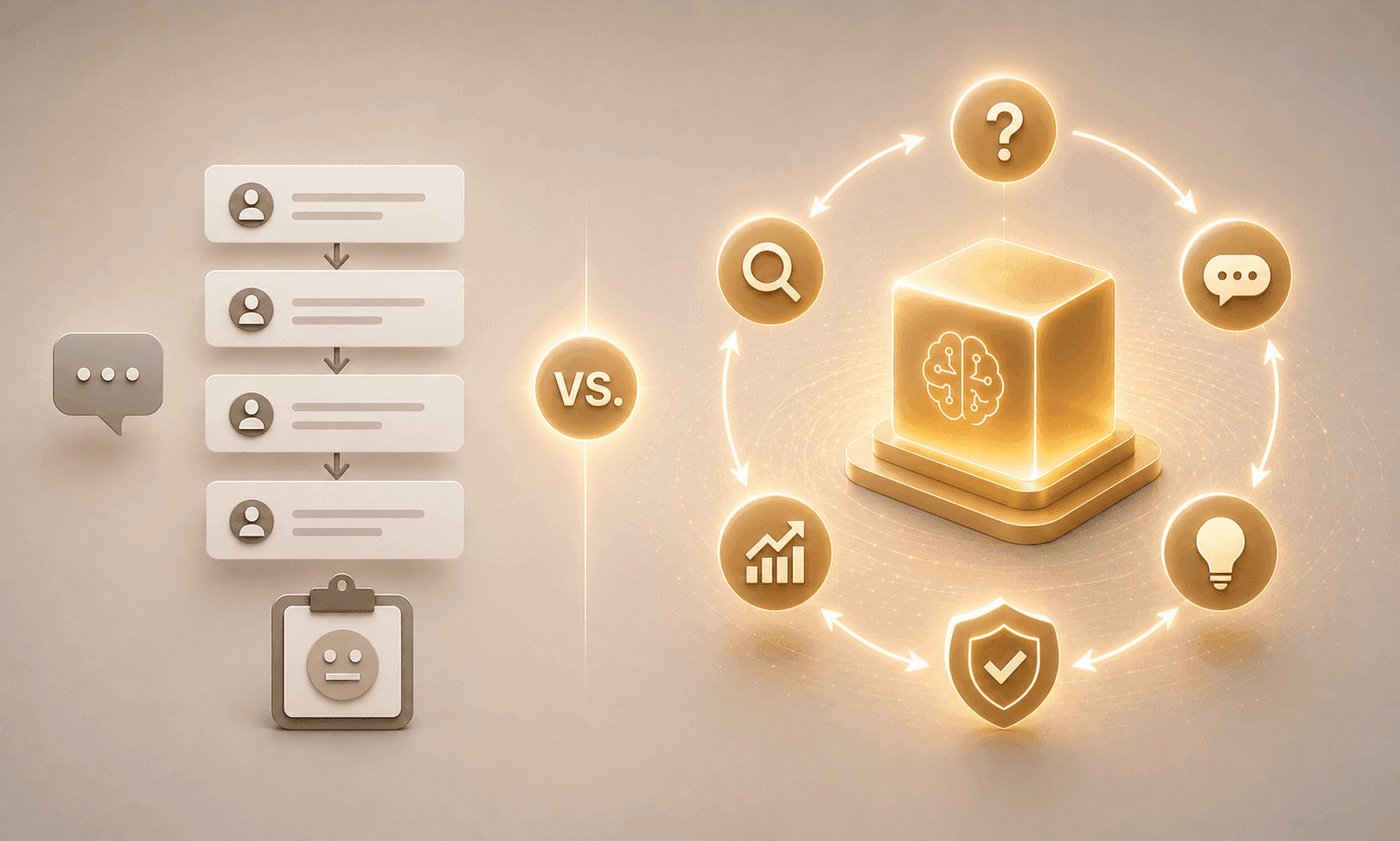
A scripted interview is a list of questions delivered by a chatbot. Every candidate gets the same questions in the same order, regardless of what they say. The "AI" is on rails. It reads questions aloud, transcribes answers, scores them against a rubric. That's not an interview. That's a survey with a voice.
An adaptive interview is something else. The AI listens to the actual answer, picks up what's specific, what's vague, what's worth probing, and asks the next question based on that. The conversation has somewhere to go because the system has somewhere to take it.
The distinction sounds technical. It's actually the whole game.
Why Reactivity Started Mattering
Two years ago, most candidates wrote their own resumes and rehearsed their own answers. Today, close to half of job seekers use AI to draft applications. Among Gen Z, the share is higher. Every candidate now arrives at the interview with answers prepared, frameworks memorized, and talking points polished to the specific job description in front of them.
Scripted interviews can't compete with this. Every question is predictable. Every candidate has prepared. Every answer sounds passable.
The interview stops separating candidates, because the candidates have already separated themselves into the ones who prepared with AI and the ones who didn't bother.
Adaptive interviews break that pattern. The candidate doesn't know what's coming next, because what's coming next depends on what they just said. Rehearsed answers don't survive contact with a follow-up question they didn't expect.
What Adaptive Actually Means
Adaptive doesn't mean random. It doesn't mean trick questions. It doesn't mean the AI is trying to catch the candidate out.
It means the AI does what a good human interviewer does:
Hears a specific claim and asks how it was actually done
Notices a vague answer and pushes for an example
Spots a contradiction and circles back to it later
Goes deeper when the candidate goes deeper
Moves on when the candidate is genuinely stuck rather than drilling them on it
The closest analog isn't a quiz. It's a senior engineer interviewing a junior engineer over coffee. They follow the conversation.
Built correctly, adaptive AI interviews do this consistently across every candidate, in every language, at any hour, without getting tired or biased by mood.
Scripted vs Adaptive: What the Comparison Actually Shows
A scripted interview reveals what the candidate prepared for.
An adaptive interview reveals what the candidate actually knows.
That's the whole difference, and it's bigger than it sounds. Three examples.
"Tell me about a time you led a difficult project."
Scripted: the candidate delivers a polished story they've used five times this month. The system scores the story. Moves on.
Adaptive: the AI hears the story and asks the follow-up. "You mentioned the team pushed back at first. What specifically did they push back on, and what changed their mind?" Now the candidate is improvising. Either they actually led the project, or they're about to invent details.
"Walk me through how you'd debug a slow API endpoint."
Scripted: the candidate lists textbook steps. Check logs. Profile the code. Look at database queries. Score: passable.
Adaptive: the AI hears the textbook answer and asks the follow-up. "Walk me through the last time you actually did this in production. What was the bottleneck?" Now you're finding out if they've ever done it or just read about it.
"Why are you leaving your current role?"
Scripted: the candidate gives the rehearsed line about looking for growth opportunities. The system records it. Moves on.
Adaptive: the AI asks what the candidate didn't prepare for. "What growth opportunities specifically would you not have in your current role?" The answer is suddenly worth listening to.
What You Actually Get from Reactivity
Six things adaptive interviews surface that scripted ones miss.
Depth of actual experience. Scripted questions reveal what someone studied. Adaptive follow-ups reveal what they've actually done.
Authenticity of claims. A candidate who exaggerated a project on their resume can handle the first question. They can't handle the third follow-up about a detail they didn't anticipate.
How the candidate thinks under pressure. Not stress for the sake of stress. Just the normal pressure of a conversation moving in a direction they didn't script for.
Communication quality. How they handle uncertainty. Whether they admit when they don't know. Whether their answers get clearer or more confused as you go deeper.
Real cultural and functional fit signals. A behavioral question gets a behavioral answer. The follow-up reveals whether the answer was a story or a script.
Fraud signals. Deepfake interviews and AI-coached candidates both struggle with adaptive questioning. The scripts they prepared for don't cover the unscripted parts. This is not a feature you can bolt onto a scripted system. The interview itself has to be reactive for it to work.
What to Actually Test in a Demo
Most demos look identical. The vendor walks you through a candidate experience with pre-baked answers, the AI asks pre-baked follow-ups, and everything goes smoothly because everything was set up to go smoothly.
To find out if the AI is actually adaptive, give the demo something it didn't expect.
Five things worth testing:
Answer a question vaguely and see if the AI pushes for specifics or just moves on
Make a strong claim ("I led a team of 50 engineers at a Series C startup") and see if the AI probes how, when, on what stack
Contradict yourself between two answers and see if the AI catches it or treats them as unrelated
Give a domain-specific answer outside the pre-baked script and see if the follow-up actually engages with the content
Say "I don't know" to a hard question and see if the AI moves on gracefully or asks the same question in different words
If the demo doesn't survive these tests, the word "adaptive" in the marketing copy is doing more work than the adaptive in the product.
The Honest Trade-off
Adaptive interviews are harder to build, harder to demo, and harder to sell than scripted ones. That's why so many vendors don't bother. A scripted interview can be assembled in a weekend. An adaptive interview needs a model that understands what the candidate just said, holds context across the conversation, and generates good follow-ups in real time. Different problem.
There are also legitimate reasons to use scripted interviews for some steps. Compliance questionnaires. Standardized assessments. Specific stages where you want every candidate to answer the same question. Fine. Use scripted for that.
But the actual interview, the part that's supposed to evaluate fit, depth, and authenticity, shouldn't be scripted. That's the part adaptive is for.
Where This Leaves You
The choice between scripted and adaptive isn't really a choice if you take the current hiring market seriously. Scripted interviews were designed for a world where candidates couldn't prepare with AI. That world ended in 2023.
The platforms still selling scripted interviews under an AI label are betting that buyers won't notice the difference. Some won't. The ones that do will find that the interview either probes the candidate or rubber-stamps them, and rubber-stamping is exactly what the candidate hopes for.
Careerswift Hire was built around adaptive follow-ups from the start. The AI generates contextual questions based on what the candidate just said, runs HR and technical interviews in the same workflow, and pairs that with the fraud detection layers that catch what the conversation itself doesn't. The interview is the interview, not a form with a voice on top.
Bring a hard candidate scenario to the demo. The good platforms welcome the test.
